
News
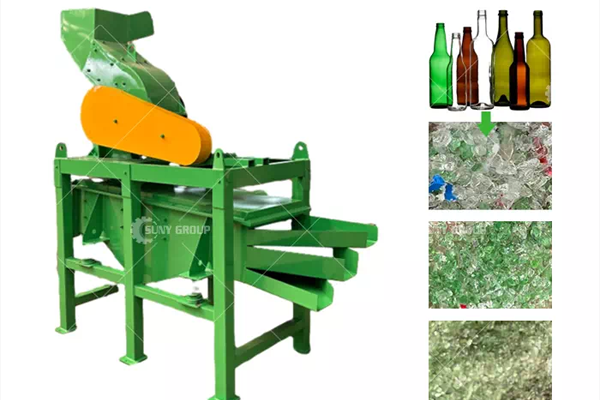
Advanced glass recycling equipment with 3 stage sorting capability
Waste glass recycling requires more than simply breaking bottles into smaller pieces. Recycling plants also need to control particle size, improve material handling, and prepare recovered glass for different downstream applications. Advanced glass recycling equipment with 3-stage sorting capability offers an integrated solution by combining glass crushing, pulverizing, and particle-size classification in one system.
SUNY GROUP’s glass crushing and sorting recycling machine is designed to process waste glass into coarse particles, medium-sized granules, and fine glass powder. Its integrated structure helps recycling businesses simplify their processing workflow, save installation space, and turn discarded glass into reusable materials.
What Is Advanced Glass Recycling Equipment?
Advanced glass recycling equipment is industrial machinery designed to reduce waste glass into smaller particles and separate the processed material according to particle size. Depending on the equipment configuration, the system can combine crushing, fine grinding, screening, and material separation.
Unlike a conventional glass crusher that primarily reduces material size, an integrated glass recycling machine also classifies the output into different fractions. This makes it easier for recycling facilities to prepare recovered glass for specific applications.
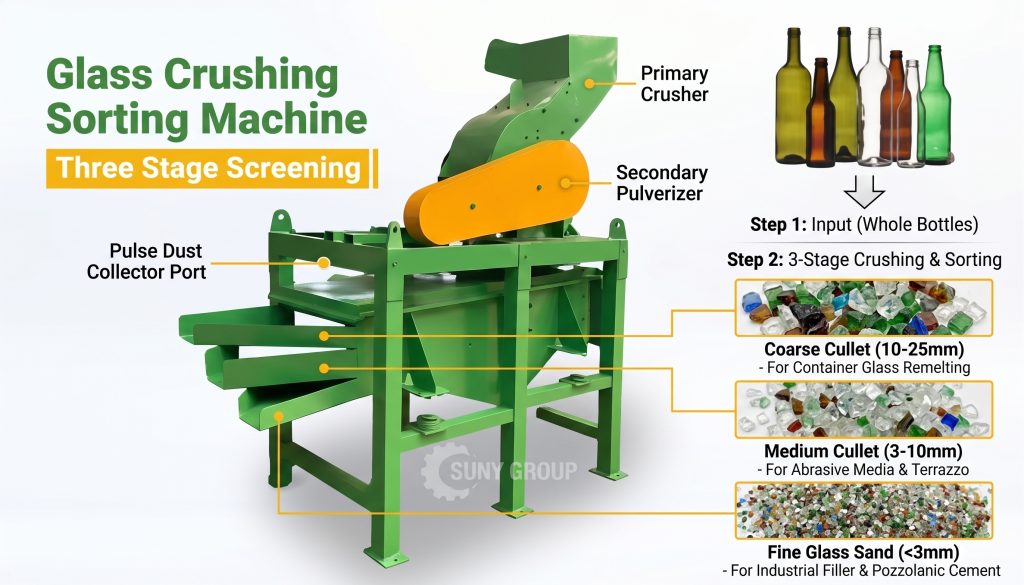
The SUNY GROUP glass crushing and sorting recycling machine features a three-layer horizontal screening system. After crushing and pulverizing, the processed glass passes through the screening system and is classified into three main output fractions:
- Coarse glass particles: Suitable for selected recycled glass and building material applications.
- Medium glass granules: Useful for downstream processing and certain construction applications.
- Fine glass powder: Potentially suitable for industrial filler applications, depending on particle size and material specifications.
The final particle size can be adjusted by changing the screen configuration and crushing structure to meet different processing requirements.
How Does a Glass Recycling Machine with 3-Stage Sorting Work?
An efficient glass recycling process combines size reduction and particle classification. The exact configuration depends on the incoming material and the desired final products.
1. Waste Glass Feeding
Waste glass, including discarded bottles, jars, and other suitable glass products, is fed into the processing system. Before processing, operators should evaluate the feed material and remove unsuitable contaminants when necessary.
Consistent feeding helps maintain a stable workflow and supports effective downstream processing.
2. Primary Glass Crushing
The crushing unit breaks larger glass items into smaller fragments. This initial size reduction makes the material easier to process in the subsequent pulverizing and screening stages.
The crushing structure should be selected according to the type, size, and quantity of glass entering the machine.
3. Glass Pulverizing
After initial crushing, the glass is further reduced in size through the pulverizing section. This stage helps produce finer particles and prepares the material for classification.
Operators can adjust the equipment configuration to suit the target particle size and intended application.
4. Three-Stage Particle-Size Sorting
The processed glass enters a three-layer horizontal screening system, which separates the material into different size fractions.
The three main outputs are coarse glass particles, medium glass granules, and fine glass powder. This classification allows recycling businesses to manage different material grades separately instead of handling a mixed-size output.
The actual particle-size ranges depend on the selected screen configuration and processing conditions.
5. Collection and Further Processing
After screening, the separated glass fractions can be collected for storage, transportation, or further processing. Their suitability for resale or reuse depends on particle size, cleanliness, glass composition, and the requirements of downstream buyers.
For applications that require strict purity standards, additional contaminant removal or quality-control procedures may be necessary.
Key Features of SUNY GROUP Advanced Glass Recycling Equipment
Integrated Crushing and Sorting
The machine combines glass crushing, pulverizing, and particle-size classification in one integrated system. This design can reduce the need for multiple standalone machines and simplify the overall equipment layout.
For facilities with limited floor space, an integrated solution may help streamline installation and material transfer.
Adjustable Output Particle Size
Different recycling applications require different glass particle sizes. The machine allows users to adjust the screen configuration and crushing structure to match their production requirements.
Before purchasing equipment, buyers should confirm the target particle-size ranges, expected output distribution, and quality requirements with the manufacturer.
Three-Layer Screening System
The three-layer horizontal screening system classifies processed glass into coarse, medium, and fine fractions. This helps recycling businesses organize their recovered materials and identify suitable downstream applications.
The screening configuration should be selected according to the characteristics of the feed material and the desired output.
Modular Design for Easier Maintenance
The modular design supports cleaning, inspection, and replacement of relevant components. Routine maintenance helps reduce avoidable downtime and supports consistent equipment operation.
Operators should follow the manufacturer’s maintenance schedule and inspect wear parts regularly.
Stable Operation
The equipment uses high-quality motors and a vibration-damping system to support stable operation. Correct installation, suitable feeding practices, and regular maintenance are also important for reliable long-term performance.
Applications of Recycled Glass Materials
According to the U.S. Environmental Protection Agency (EPA), glass recycling plays an important role in waste management and material recovery, making efficient glass processing equipment valuable for recycling facilities.
Properly processed waste glass can serve as a secondary raw material for several industries. The appropriate application depends on the recovered material’s particle size, cleanliness, composition, and quality specifications.
Recycled Glass Manufacturing
Crushed glass can be used as a feedstock for further glass manufacturing processes when it meets the required material specifications. Consistent particle sizing can help improve handling and preparation for downstream operations.
Construction Materials
Selected recycled glass fractions may be used in certain building material applications, aggregates, or decorative products. However, suitability depends on the specific application and relevant technical requirements.
Industrial Fillers
Fine glass powder may be considered for industrial filler applications where its particle size and composition meet the buyer’s specifications. Testing is recommended before commercial use.
Waste Management and Resource Recovery
Glass recycling facilities, waste management companies, and material recovery businesses can use integrated glass processing equipment to convert suitable glass waste into more manageable, potentially reusable material fractions.
Why Choose an Integrated Glass Crushing and Sorting Machine?
When comparing glass recycling equipment, buyers should consider the entire processing workflow rather than focusing only on crushing performance.
An integrated machine offers several potential advantages:
- Simplified processing: Combines multiple processing functions within one system.
- Space efficiency: May reduce the floor space needed compared with separate equipment units.
- Flexible output: Allows particle-size adjustment according to processing requirements.
- Easier maintenance planning: A modular structure supports inspection and component replacement.
- Improved material utilization: Separating glass into different size fractions can create more options for downstream use.
Actual production capacity, energy consumption, output quality, and operating costs depend on the equipment configuration, feed material, and operating conditions. Buyers should request technical specifications and confirm performance requirements before making an investment.
How to Select the Right Glass Recycling Equipment
Choosing the right glass recycling machine starts with a clear understanding of the project.
Before requesting a quotation, prepare the following information:
- Glass type: Specify whether you process bottles, jars, flat glass, or other glass waste.
- Processing capacity: Provide the required capacity in kilograms or tons per hour.
- Target particle size: Explain the required size range for coarse, medium, and fine outputs.
- Material cleanliness: Describe any labels, caps, metals, plastics, or other contaminants in the feed.
- Final application: Identify whether the recovered glass will be used in manufacturing, construction, industrial fillers, or another application.
- Installation conditions: Confirm available floor space, power supply, and site requirements.
These details help the manufacturer recommend a suitable configuration and provide a more accurate quotation.
Get a Quote for Advanced Glass Recycling Equipment
SUNY GROUP provides glass crushing and sorting equipment designed to help businesses process waste glass into reusable material fractions. The integrated system combines crushing, pulverizing, and three-stage particle-size sorting to support different glass recycling requirements.
If you are planning a glass recycling project, visit our Glass Crushing Sorting Recycling Machine product page to learn more about the equipment.
Contact our team with your glass type, required processing capacity, target particle size, and intended application. We can then discuss a suitable equipment configuration for your project.
Contact SUNY GROUP
- WhatsApp: +86 18937107672
- Email: ecosanequip@gmail.com
Frequently Asked Questions
What is advanced glass recycling equipment?
Advanced glass recycling equipment processes waste glass through crushing, pulverizing, and screening. Integrated systems can classify processed glass into different particle-size fractions for subsequent recycling or reuse.
What does 3-stage glass sorting mean?
In this machine, 3-stage sorting refers to particle-size classification using a three-layer horizontal screening system. The resulting fractions include coarse glass particles, medium glass granules, and fine glass powder.
What types of glass can this machine process?
Suitable feed materials may include waste glass bottles, jars, and other compatible glass products. Confirm the suitability of flat glass, laminated glass, tempered glass, or contaminated glass with the manufacturer before processing.
Can the output particle size be adjusted?
Yes. The equipment’s particle size can be controlled by adjusting the crushing structure and screen configuration. The achievable output size should be confirmed according to the project requirements.
What information is needed for a glass recycling machine quotation?
Provide the glass type, required processing capacity, target particle size, material condition, and intended application. These details help determine the appropriate equipment configuration.
Contact Us
Address
Henan Communication Industrial Park, Economic Development Zone, Zhengzhou City, Henan Province, China